




09/07/2026
How A Medical Bergen Supports Deployment Readiness And Organised Casualty Care
In His Majesty’s Armed Forces, a ‘bergen’ is the large rucksack used by personnel to carry equipment beyond the soldier's immediate webbing load. The term itself is derived from ‘Bergans’, the Norwegian manufacturer whose framed rucksacks influenced military load carriage during the early twentieth century. Forces News distinguishes it from Personal Load Carrying Equipment (PLCE), which keeps essential items accessible on the body.

A medical bergen essentially adapts the same familiar rucksack format for clinical equipment. The National Army Museum's example, used by a Royal Army Medical Corps soldier in Helmand in 2007, carried airway equipment, dressings, a tourniquet, a laryngoscope, a neck brace and other medical supplies. It gives a dismounted medic room for a broader treatment load than an Individual First Aid Kit (IFAK) or compact trauma bag.
However, Capacity Alone Does Not Make A Medical Bergen Deployment-Ready.
For a medical bergen, deployment readiness means knowing before you move that every treatment module is present, correctly packed and immediately accessible when you reach the casualty. The bergen connects those requirements in three ways:
1. It Groups Equipment By Clinical Function
Items likely to be used together are packed into clearly defined modules for the relevant treatment task. An airway module, for example, forms an identifiable working unit with its contents kept together in the same section. The medic can check that unit before deployment, while reserve quantities remain clearly identifiable as reserve stock.
2. It Holds Each Module In A Known Position
Internal retention and compression prevent dense items from settling at the bottom or one section moving into another. The medic then opens the same arrangement checked before deployment, with each module still where expected.
3. It Works As Part Of Your Complete Load
Your body armour, belt kit, water, communications equipment and other carried items all affect where the bergen sits and how you move under load. The Ministry of Defence’s Science of Human Performance guide explains that load carriage alters movement patterns and increases the forces acting on the body. Harness fit, pack shape and weight distribution therefore need to be assessed with the full equipment ensemble you will actually wear on deployment
How Does The Same Layout Organise Casualty Care?
At the casualty, the relevant module moves out of the medical bergen as a complete treatment unit. Equipment packed for the same clinical task arrives together, while the main load retains the other modules in their known positions. If treatment requires equipment from several modules, you can bring each clearly identified pouch into the working area as it is needed, while the remaining load stays organised inside the bergen.
This also helps organise the casualty handover process, as with a standardised modular system another medic won’t need to learn an entirely personal packing system while care is under way. Shared module names, consistent orientation and visible identification procedures show what remains in the bergen and what has already entered the treatment space.
If something has been used, the module leaves an empty space inside the bergen, with internal dividers or compression holding the surrounding sections in place so they do not fall or slide into it. The bergen keeps a stable carrying shape, and the reserve modules remain where the next medic expects to find them.
The normal layout then becomes the reference point for handover. If an unopened module is still in its assigned position, the incoming medic can see that it remains available. The handover can concentrate on what has changed, such as the active module, equipment issued elsewhere and any reserve stock already used.
This is the connection between deployment readiness and organised casualty care:
- Before movement, the medical bergen creates a defined treatment load that can be checked.
- During care, the medic removes the required modules while the reserve stays in order.
- Afterwards, the same layout shows what remains available for the next requirement.
Find Out More?
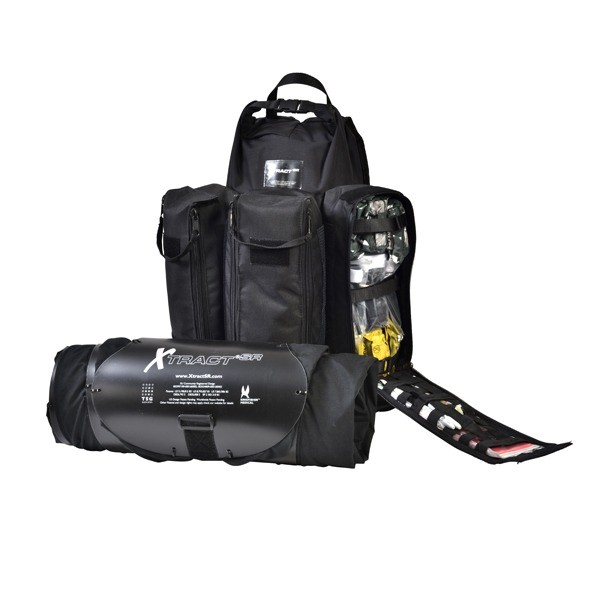
The Xtract™SR Equaliser from TSG pairs removable pouches with a protected working space, helping you maximise the operational efficiency of your medical bergen. To find out more or to discuss your operational needs, please contact one of our specialists today by clicking here.