





27/08/2026
How A Medic Tactical Bag Supports Fine Motor Control Under Pressure
Acute stress can make fine motor control less reliable just when you need it the most. Increased muscle tension, narrowed attention, physiological stress, and rushed movements can negatively affect the small, precise actions required for opening sterile packs, manipulating connectors and securing dressings. Cold, fatigue and protective gloves can add further difficulty.

A medic tactical bag cannot remove those pressures, but it can reduce the number of delicate movements required before treatment begins. Large opening handles, visible equipment and a stable working surface leave more of your dexterity available for the clinical task itself. Read on to find out more.
Dexterity Under Pressure Varies By Person And Situation
A Canadian review of acute stress and skilled motor performance in policing from 2019 reports that physiological responses can vary widely between individuals and situations. The level of threat, physical effort, novelty, familiarity and previous experience all heavily shape that response. For instance, under test conditions, a reading of operatos’ heart-rates alone could not define a universal point at which fine motor control disappears. This underlines the importance of both experience and technique, because a well-rehearsed movement may remain reliable under conditions that disrupt a less familiar action, and gross motor movements are often easier to recall under pressure than more intricate fine motor movements. A medic tactical bag therefore needs to remain easy to access across a range of stress responses, rather than assuming that every medic’s dexterity will be affected in the same way. How does design facilitate this?
Turns Opening Into A Whole-Hand Movement
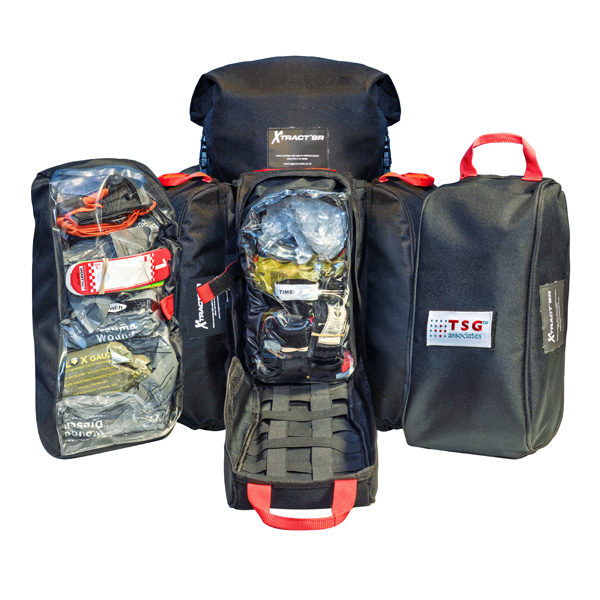
Fine motor control comes from small, coordinated movements of the fingers and thumb. A narrow zip pull demands exactly that: you have to locate it, pinch it securely and guide it around the bag while keeping the pack steady. With the palm and all four fingers around a large pull handle, the opening force comes from the hand and arm. In these cases, the thumb and forefinger no longer have to maintain a pinch while the closure travels around a corner. The no-zip opening on the Xtract™SR Equaliser uses this movement to expose the equipment inside the bag in one deliberate action.
Lets Your Eyes Select The Item First
Once the bag is open, you still have to find the selected item. When several similar packets overlap inside a deep pouch, you have to separate them, turn them towards the light and check each one. That adds several fingertip movements before the selected item reaches the casualty.
A fixed, visible layout allows you to choose the item before reaching into the bag. Elastic and Velcro tabs can hold equipment in its assigned position during carriage, then allow you to release the selected module without undoing several small catches.
Accounts For Gloves, Cold And Working Posture Together
A 2022 Polish pilot study into protective gloves and manual dexterity in cold environments found that the type of protective glove used changed how long participants took to complete manual tasks at +5°C and -1°C. Because the six participants completed non-clinical tasks, the study cannot directly quantify the effect on military medics in the field. However, it does show why the medic tactical bag has to work with the glove and temperature expected on deployment.
Gloves increase the size of the hand and reduce how easily you can feel a small edge or tab, with a direct impact on fine motor tasks. When you use a medic tactical bag with gloves, you need enough handle area for a full grip and enough clearance to get your fingers around a pouch. The handle also has to remain reachable when body armour or a kneeling position limit how far you can turn towards the bag.
What Next?
Stress, cold, fatigue, gloves and a restricted working position can all make small hand movements less reliable. A well-designed medic tactical bag won’t remove those conditions, but it can stop them being compounded by narrow zip pulls, concealed equipment or an unstable working surface. By simplifying access to the loadout, it preserves your finer movements for opening packs, handling connectors and carrying out treatment.
To compare the Xtract™SR Equaliser’s no-zip opening, visible layout and detachable tray with the actions your current bag requires when you are gloved or kneeling, please contact one of our team today by clicking here.