






15/05/2026
How Hypothermia Affects Blood Clotting And Why It Makes Bleeding Worse?
In trauma care, medical attention is naturally drawn first to what can be seen, such as blood loss, wound severity, and the speed at which both are progressing. Interventions follow accordingly, e.g. pressure, tourniquets, packing, each aimed at physically interrupting that loss. These actions are essential, but they can create a narrow focus. Once the bleeding appears under control, it is easy to assume that the underlying problem has been resolved.

This assumption depends on the body maintaining its ability to clot. This capacity is not fixed, however, but shifts with the casualty’s physiological state, and core body temperature plays a decisive role in that shift. A wound can be well managed externally while the internal processes required to stabilise it are quietly deteriorating.
Looking at c brings this into focus. Bleeding is not only about the point of injury; it is also about whether the body can complete the process that those interventions contribute to. Without that, control is temporary at best. So, how does hypothermia affect blood clotting, and what can be done about it?
The physiology of clotting under temperature stress
Haemostasis relies on a sequence of reactions that function within a narrow range of conditions. At around 37°C, clotting enzymes operate efficiently, platelets respond quickly to vascular injury, and fibrin forms a stable matrix to secure the clot.
As body temperature falls, these processes begin to lose efficiency. Between 33–36°C, the changes are subtle but meaningful. Enzymatic reactions slow down, extending the time required for clot formation. Platelets remain present in circulation but become less effective in adhering and aggregating at the injury site. The result at this temperature range is not an absence of clotting, but a reduction in its reliability.
Below 33°C, the decline becomes more pronounced. Enzyme activity is significantly impaired, and platelet dysfunction is evident. Clots that do form are weaker and more susceptible to disruption. For example, a wound that initially appeared stable may begin to bleed again, not because of renewed trauma, but because the biological support for that stability has weakened. This is the practical reality behind hypothermia blood clotting impairment: the body’s healing system remains in place, but it no longer performs at a level that matches the demands of the injury.
Hypothermia as a driver of trauma-induced coagulopathy
In injured patients, hypothermia usually develops alongside other physiological stresses, rather than in isolation. Blood loss reduces circulating volume and compromises perfusion, tissue damage triggers inflammatory responses, and reduced oxygen delivery leads to acidaemia – the well-named ‘Lethal Triad of Hypothermia, Acidosis and Coagulopathy”of traumatic injury management. Each of these factors affects coagulation; together, they interact in ways that accelerate deterioration.
Temperature decline obviously feeds directly into this process. As enzymatic activity slows and platelet function weakens, the effects of shock and acidaemia become more difficult to counterbalance. The coagulation system, already under strain, loses further efficiency.
This interaction explains why hypothermia and blood clotting are closely linked within Trauma-Induced Coagulopathy. The issue is not simply that multiple problems are present, but that each one intensifies the others. A small drop in temperature, when combined with ongoing haemorrhage and metabolic disturbance, can have disproportionate effects on clotting performance.
Unlike some aspects of trauma physiology, temperature can change rapidly in the prehospital phase, particularly in exposed or wet environments. That speed of onset makes it a key factor in how quickly coagulopathy develops.
Why trauma patients fare worse than accidental hypothermia cases?
A fall in core temperature carries different consequences depending on what else is happening in the body. In accidental hypothermia blood clotting without injury, physiological processes might slow, but they are not under immediate pressure from other factors. There is no active bleeding, for instance, and no competing demand on clotting mechanisms.
The situation is very different in trauma. Blood is being lost at the same time as the body’s ability to stop that loss is declining, creating a vicious circle of decline. Circulating volume drops, which worsens perfusion and contributes to further heat loss. Tissue injury sustains inflammatory activity. Clotting is required continuously, yet becomes progressively less effective.
This helps explain why outcomes so often diverge between injured and non-injured hypothermic patients at the same temperature. In trauma, the physiological demands are immediate and ongoing, while the capacity to meet them is diminishing.
Operational implications: temperature control as immediate intervention
The effects of hypothermia on clotting have direct implications for how haemorrhage is managed in the field. Preventing heat loss is not simply supportive care; it also influences whether the patient’s clotting mechanisms remain functional.
Timing is central. If thermal protection is delayed until evacuation or hospital care, the period of greatest vulnerability may have already passed without intervention. During that time, temperature may fall enough to impair clotting in a way that is difficult to reverse quickly.
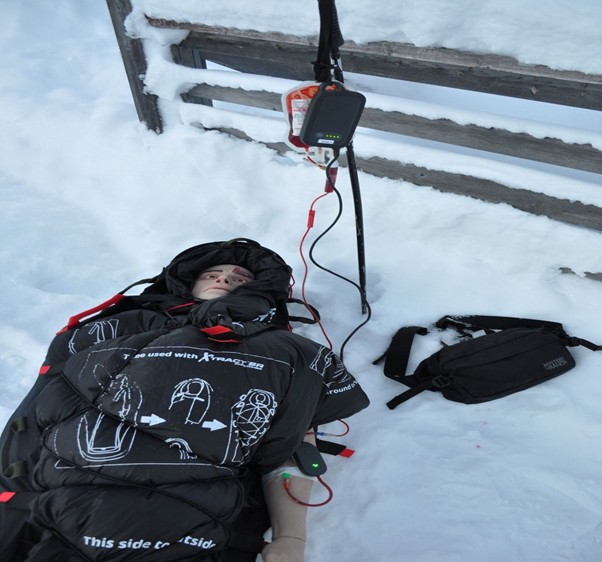
Fortunately, early interventions are often straightforward, such as insulating the casualty from the ground, reducing exposure, replacing wet clothing, and applying thermal layers – but their value depends on when they are applied. Preserving temperature helps maintain the conditions required for effective haemostasis.
Recognising temperature management as an intrinsic part of haemorrhage control changes how priorities are set at the point of injury, helping align your interventions with the physiology that ultimately determines whether bleeding stops or continues.
Find out more
At TSG Associates, we work with military, security, and specialist healthcare teams to translate clinical principles into practical capability; ensuring that factors like temperature management are understood, prioritised, and applied where they matter most. To find out more, please contact one of our specialists today by clicking here.